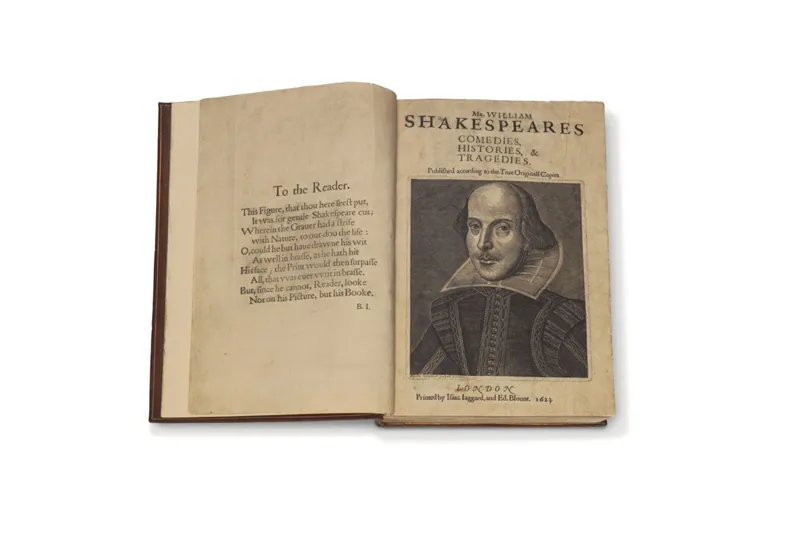
If you are an antique book collector with really deep pockets, The Economist, 19 April 2023, has a delicious story that might tempt you. William Shakespeare died in April 2016. After hard effort to locate all of his scattered writings, the printers put together the complete ‘Master Shakespeare’s Works’. That first print run in 1623 was around 750 copies; some 235 are known to have survived. Depending on quality and completeness, just a handful of those folios have sold at auction for between $5.7 and $9.8 million, in the years 2001-2021 (Christie’s).
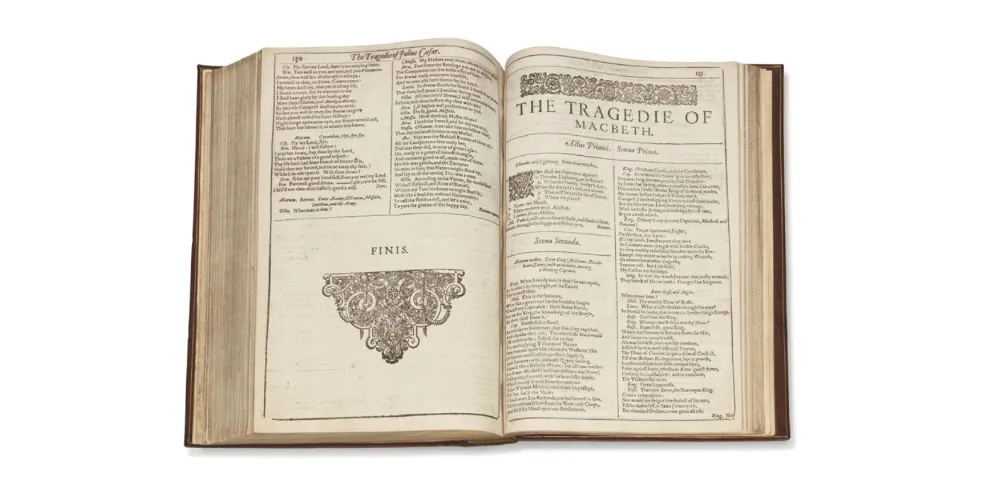 William Shakespeare's First Folio. Image Christie's
Coinciding with the 400th anniversary of the original publication, someone has taken the trouble to recreate a complete specimen, essentially the original material, supplemented with very high-quality duplicates and a special quality binding. Voila, a new original, complete specimen of one of the world’s greatest works.
Peter Harrington, a London antiquarian, is offering that copy, earlier with a private collector, for a mere $7.5 million! Most people would probably calculate that the value will surely go up in the years ahead, but that’s a bet for the buyer.
It is fascinating that most of the extremely valuable antique books, even those of modest standing, and therefore very much cheaper, are held by private book lovers, just for the sheer joy of having an old book. That passion has survived the e-book era. Let’s accept, for all their practicality and portability, with digital versions we miss the personal intimacy of the physical book.
I am not a collector, but some 10 years back Sir John Boyd (1936-2019), gave me a lovely leather-bound copy of Charles Dickens Barnaby Rudge. John was a close friend since 1962, a fellow-student learning Putong Hua Chinese at Hong Kong. That book’s onion-skin 800 pages make for a small volume, barely an inch-thick. The publication date is not given, (the antiquarian wrote in pencil ‘c.1925’). It was printed: ‘University Press Oxford by John Johnson’, with 76 exquisite, detailed illustration, offering vivid images for the mind’s eye to track the story.
That book sits at my bedside, with three piles of other ‘current’ books. Dipping into it at erratic intervals, I use a handwritten list of the main characters, a reminder for the complex, multi-layered plot. Having read 290 pages in about two years, I should complete the reading in another two years. It evokes the aroma of old friendship.
(The writer is a former diplomat, teacher, and author.)